Dimensions
1 x 1 x 0.09 mm3

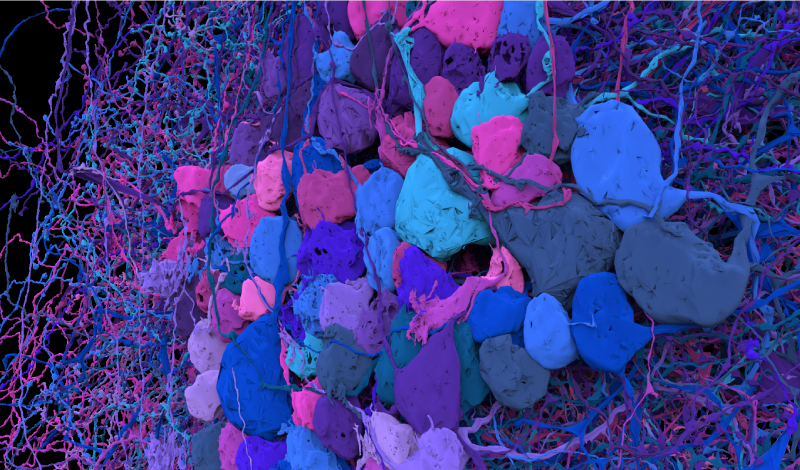
The retina forms the basis of vision: It is a multilayered neural tissue at the back of the eye that converts light into electrical signals. It is here that the first steps of visual computation are performed - including adaptation to brightness and contrast, and the detection of object motion and direction. This information is then shipped off to the brain via the optic nerve.
Our dataset was imaged with electron microscopy, resulting in a (1 mm x 1 mm x 90 µm) volume of the mouse retina at nanometer resolution. We then segment the volume into cells with machine learning tools and expert proofreading. The volume contains ca. 100,000 retinal neurons in total, spanning across all synaptic layers of the retina (from ganglion cell layer to parts of the outer plexiform layer). This brings full reconstruction of the retinal connectome into reach - which will grant us greater understanding of how cells in the retina work together to form the basis of vision.
EyeWire II is an online community for proofreading, annotation, and scientific discovery in this new mouse retina dataset. In January 2025, the dataset was segmented and proofreading by researchers and citizen scientists began. By September 2026, ca. 37% of all cells have been proofread, and more than 120 retina researchers from all over the world have joined Eyewire II to use the data for their scientific work.
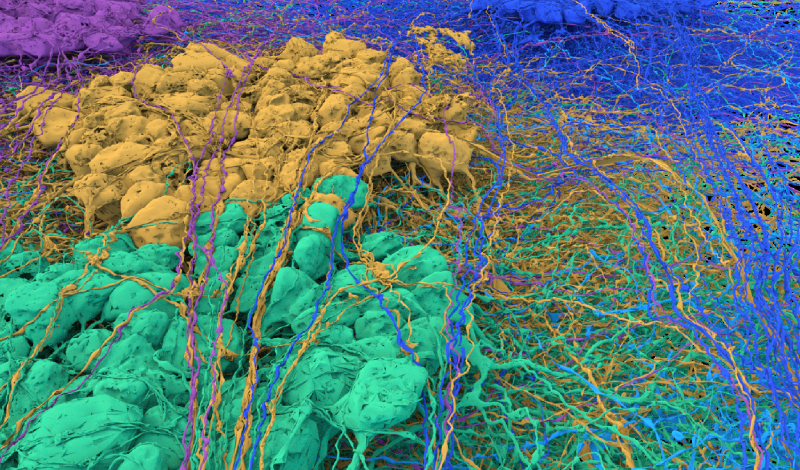
A community of neurobiologists, computer scientists, proofreaders, and citizen scientists who help build the EyeWire II dataset by mapping and identifying neurons. Join and contribute community data for your lab to appear.

RPB Transformational Team Science Award
The core support came from Princeton Neuroscience Institute (PNI) and the National Institutes of Health (NIH). The Seung lab receives support with compute resources from Amazon and Google. The Seung and Euler labs were supported by the NIH (5U01N5090562). The Euler and Berens labs were supported by the DFG (SPP 2041, 313856816). The Berens lab received funding from the ERC (NextMechMod, 101039115) and the Hertie Foundation. Eyewire II is supported through the Transformational Team Science Award from Research to Prevent Blindness (RPB).